Strength ratios: what a balanced lifter looks like
Squat, deadlift, bench and overhead press ratios a coach can use to spot a lagging lift, with target ranges and what to do when a client is out of balance.

Coach at Omnia Personal Training and co-founder of Trainnode · 4 min read
A client can get stronger every month and still drift out of balance. Strong legs and a weak upper back. A big bench and a press that never moves. Strength ratios compare each lift to one anchor lift, so you see which one is lagging behind before it limits progress or shows up as a sore shoulder.
How strength ratios work
Pick one lift as the anchor, usually the back squat, because most clients train it and it reflects overall lower-body strength. Express every other lift as a share of it:
ratio = lift's estimated 1RM ÷ anchor's estimated 1RM
A client who squats 100 kg and benches 70 kg has a bench-to-squat ratio of 0.70.
Use estimated one-rep maxes from regular training sets. You don't need to test anyone's max to do this.
Target ratios for general strength clients
These ranges are starting points for recreational lifters. They are not laws, and they shift with body type, training history and goals.
| Lift | Ratio to back squat | Example at a 100 kg squat |
|---|---|---|
| Deadlift | 1.15 to 1.25 | 115 to 125 kg |
| Hip thrust | 1.2 to 1.5 | 120 to 150 kg |
| Bench press | 0.70 to 0.80 | 70 to 80 kg |
| Overhead press | 0.40 to 0.50 | 40 to 50 kg |
A few patterns coaches see again and again:
- Deadlift well above 1.3 × squat. Often a squat technique or mobility issue rather than an exceptionally strong back.
- Bench far ahead of overhead press. Common in clients who trained alone for years. Shoulder health usually benefits from bringing the press up.
- Everything low against a strong squat. The client may simply squat much more often. Check the program before blaming the client.
Our strength ratio calculator works out the ratios for any set of numbers, and strength standards compare lifts to bodyweight.
What counts as out of balance
Deviation is how far the actual ratio sits from the target, as a percentage:
| Deviation | Read it as |
|---|---|
| Within ±10% | Balanced. Nothing to do. |
| 10 to 20% under | Lagging. Give it more attention in the next phase. |
| More than 20% under | Ask why. Injury history, technique, or a lift the client avoids. |
| More than 10% over | Usually fine. Check that the anchor isn't held back by something. |
How to use ratios in programming
- Check ratios at the end of each phase, not every week. They move slowly.
- Fix one lift at a time. Add volume to the lagging lift for four to six weeks and keep the rest steady.
- Talk about it with the client. "Your legs are strong, your upper body is catching up" is a clear, motivating story.
- Don't chase a perfect profile. A client with a bad shoulder who never benches heavy can still be a well-trained client.
Ratios for clients with an injury history
Ratios assume every lift is trained hard. For a client with an old shoulder or back injury, that's often not true, and it shouldn't be.
- Leave out lifts they can't load safely. A client who presses with a landmine instead of overhead shouldn't be measured against an overhead press target.
- Use a variation as the anchor. A trap bar deadlift or a goblet squat can anchor a collection just as well, as long as the client trains it regularly.
- Watch the side that was injured. For single-leg work like split squats, compare left and right. A difference of more than 10% is worth a conversation with the client's physio.
The goal is the same: find the lift that holds the client back. Sometimes that lift is one they avoid for good reasons, and then the ratio tells you about their history, not their training.
In Trainnode
See every client's ratios against your targets
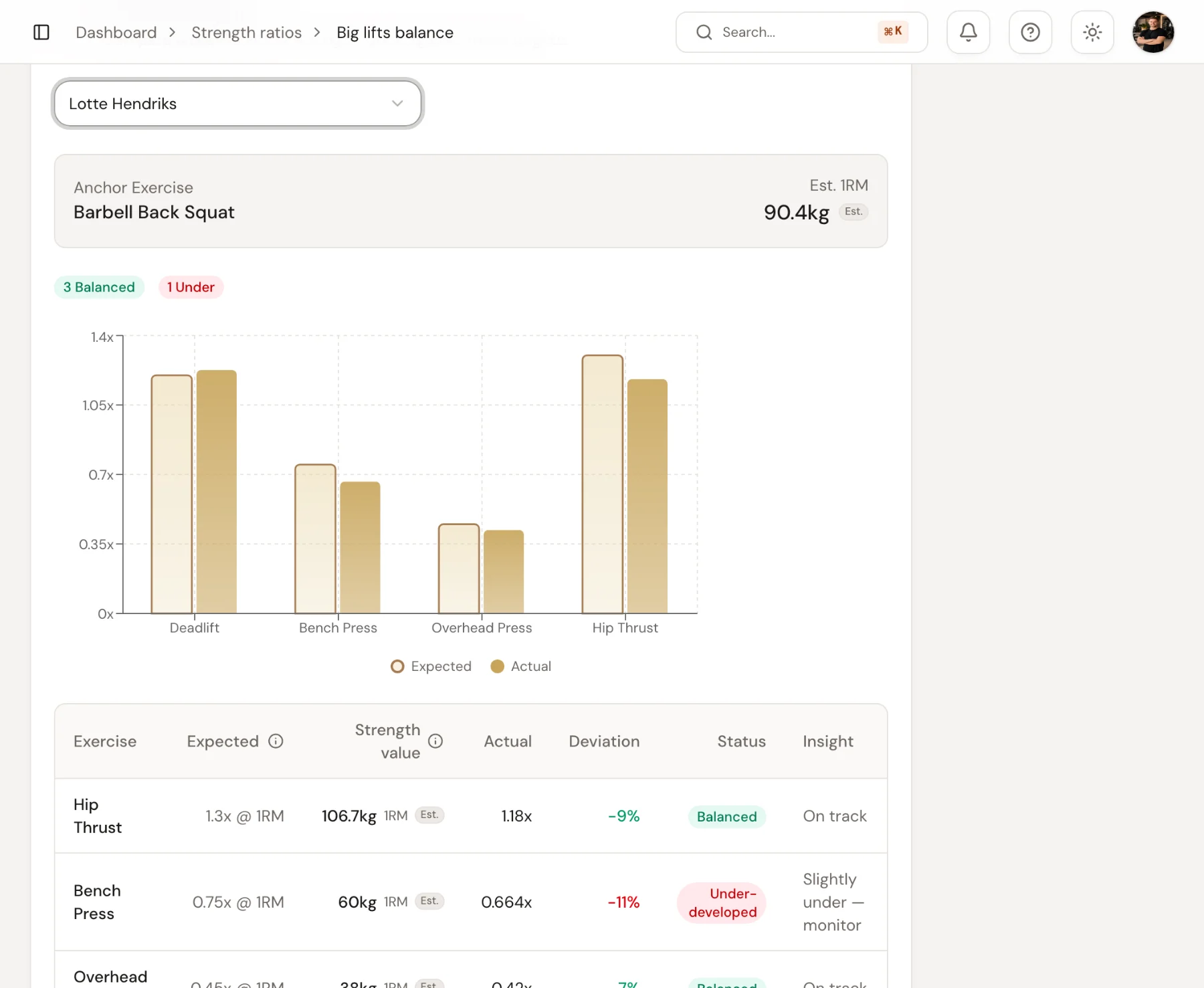
In Trainnode you set targets once as a collection and check any client against them.
- Under Strength ratios, create a collection with an anchor lift and a target ratio for each other lift.
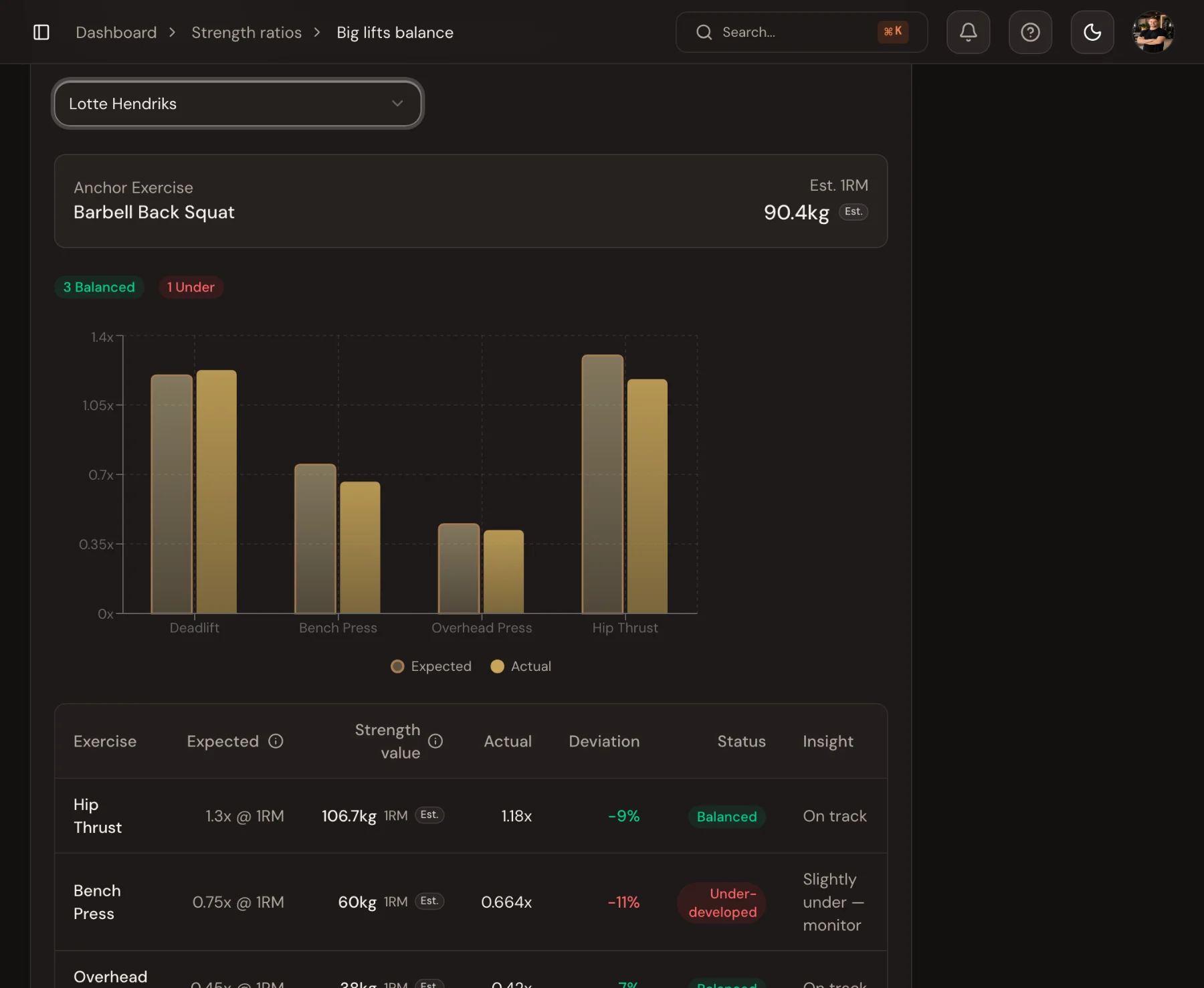
- Pick a client. Trainnode calculates estimated maxes from what they logged and marks each lift balanced, over or under, with the deviation.
- Use the chart in a review, and let the lagging lift shape the next phase in the plan builder.
Questions
Do ratios work for beginners?
Not in the first two or three months. Beginners get stronger mostly by learning the movements, so ratios jump around. Start using them once lifts settle.
Should I use a different anchor?
Use the lift the client trains most often and most consistently. For clients who don't squat, the deadlift or leg press can be the anchor.
Are ratios different for men and women?
The ranges overlap a lot. Many women have relatively stronger lower bodies, so upper-body ratios can sit at the lower end of the range and still be balanced.