How to plan a PT client's training in phases
Plan personal training in four to six week phases: what each phase is for, how many workouts it needs, how to progress loads and when to change the plan.

Coach at Omnia Personal Training and co-founder of Trainnode · 4 min read
Many PT clients train session by session: the coach decides on the day what to do. It works for a while, and then progress stalls, because nothing builds on anything. Planning in phases gives every session a place in a bigger story, for the coach and the client. "We're in week three of the strength phase" is a reason to show up.
What a phase is
A phase, also called a block, is a stretch of four to six weeks with one main goal. The same two or three workouts repeat each week, so you can see progress from one week to the next. At the end, you look at what changed and plan the next phase.
Why four to six weeks:
- Shorter, and the body hasn't adapted yet when you change things.
- Longer, and clients get bored and progress flattens.
- Four to six matches how clients think: "until the end of next month".
A simple three-phase plan
For a general strength client training twice a week:
| Phase | Weeks | Goal | Typical sets and reps |
|---|---|---|---|
| Build | 4 | Volume and clean technique on the main lifts | 3 to 4 sets of 8 to 10 |
| Strength | 4 | Heavier loads, fewer reps | 4 to 5 sets of 3 to 6 |
| Peak and test | 2 | Lighter week, then test or a hard top set | 2 to 3 sets of 1 to 3 |
After the test, start again from Build with heavier numbers, or change the focus based on what you learned.
How many workouts per phase
Match the number of different workouts to how often the client trains:
| Sessions a week | Workouts in the phase | Example |
|---|---|---|
| 1 | 1 full-body workout | Full body A |
| 2 | 2 workouts | Lower A, Upper A |
| 3 | 2 or 3 workouts | Lower A, Upper A, Lower B |
Repeating workouts is the point. A client who does the same squat session four Mondays in a row can see 70, 72.5, 75 and 77.5 kg in their log. A client who does four different sessions sees nothing.
Progressing within a phase
Pick one way to progress per exercise, and tell the client what it is.
- Add load when they hit the top of the rep range on every set. 8 to 10 reps at 60 kg: once they get 3 × 10, go to 62.5 kg.
- Add reps for exercises where load jumps are too big, like dumbbell work and bodyweight exercises.
- Add a set in the first weeks of a volume phase.
Write the rule on the workout, so a client training alone knows what to do.
Keep exercises the same within a phase
Change the exercises between phases, not within them. If the squat variation changes every week, you can't tell whether the client got stronger or just better at a new movement.
- Main lifts stay fixed for the whole phase: the same squat, hinge, press and pull.
- Accessory work can rotate every two weeks if a client gets bored, as long as it trains the same muscles.
- Swap an exercise only for a reason: pain, equipment that's taken, or a movement the client can't do well yet.
At the start of a new phase, keep at least one main lift from the last phase. It gives you and the client a number to compare across the whole year.
Check the balance before you start
Look at the whole week before assigning a phase. Count how many hard sets each muscle group gets. Common gaps in PT programs:
- Plenty of pressing, very little pulling
- Lots of quads, little for hamstrings and glutes
- No direct work for the lift that lags behind (see strength ratios)
When to change the plan
Change a phase early when:
- The client is injured or ill for more than a week
- Check-ins show poor sleep and low energy for two or three weeks running
- A lift stops moving for three sessions in a row
Otherwise, finish the phase. Changing plans every week is the most common reason clients don't progress.
In Trainnode
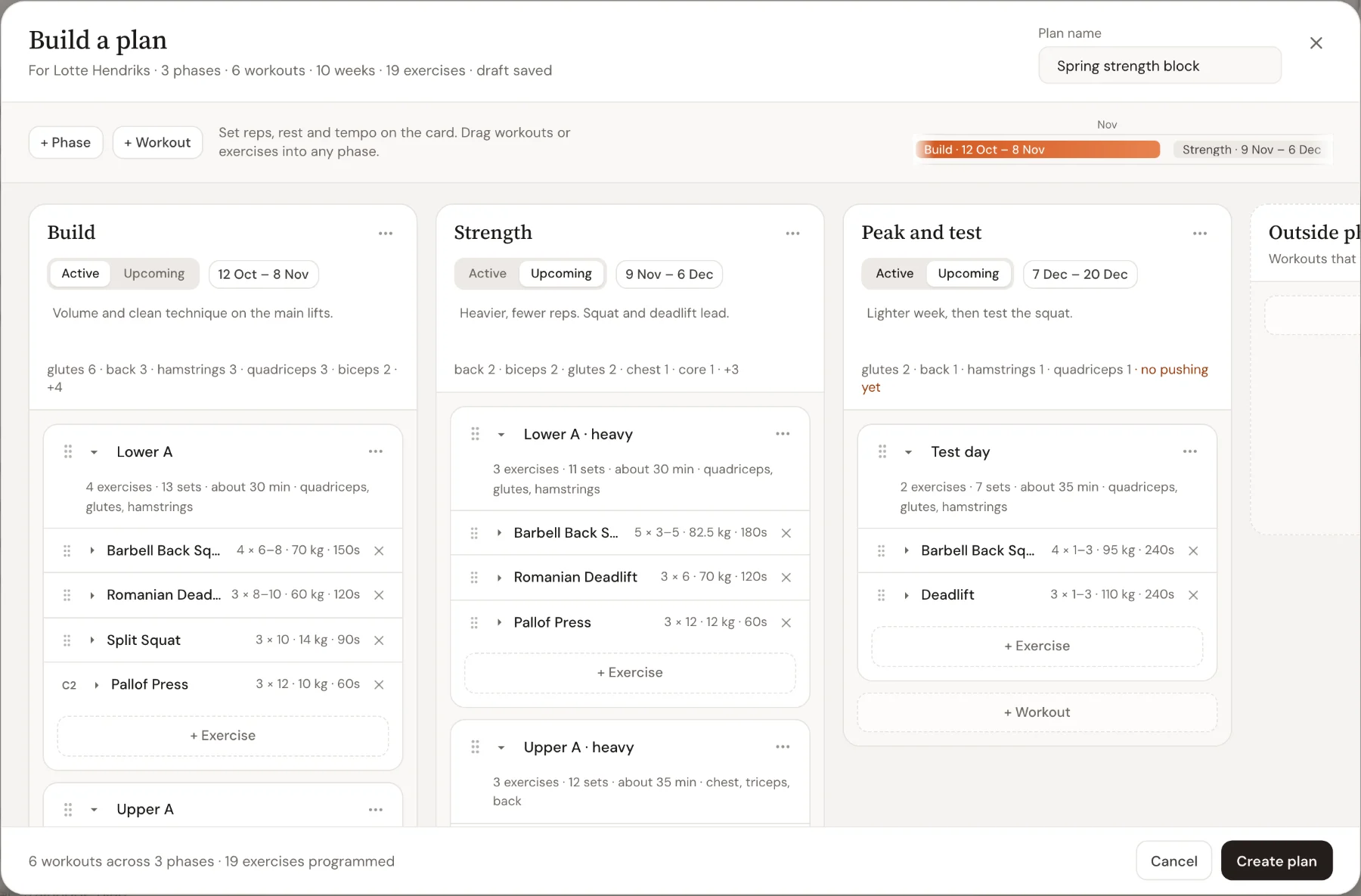
Build a whole plan for a client on one board
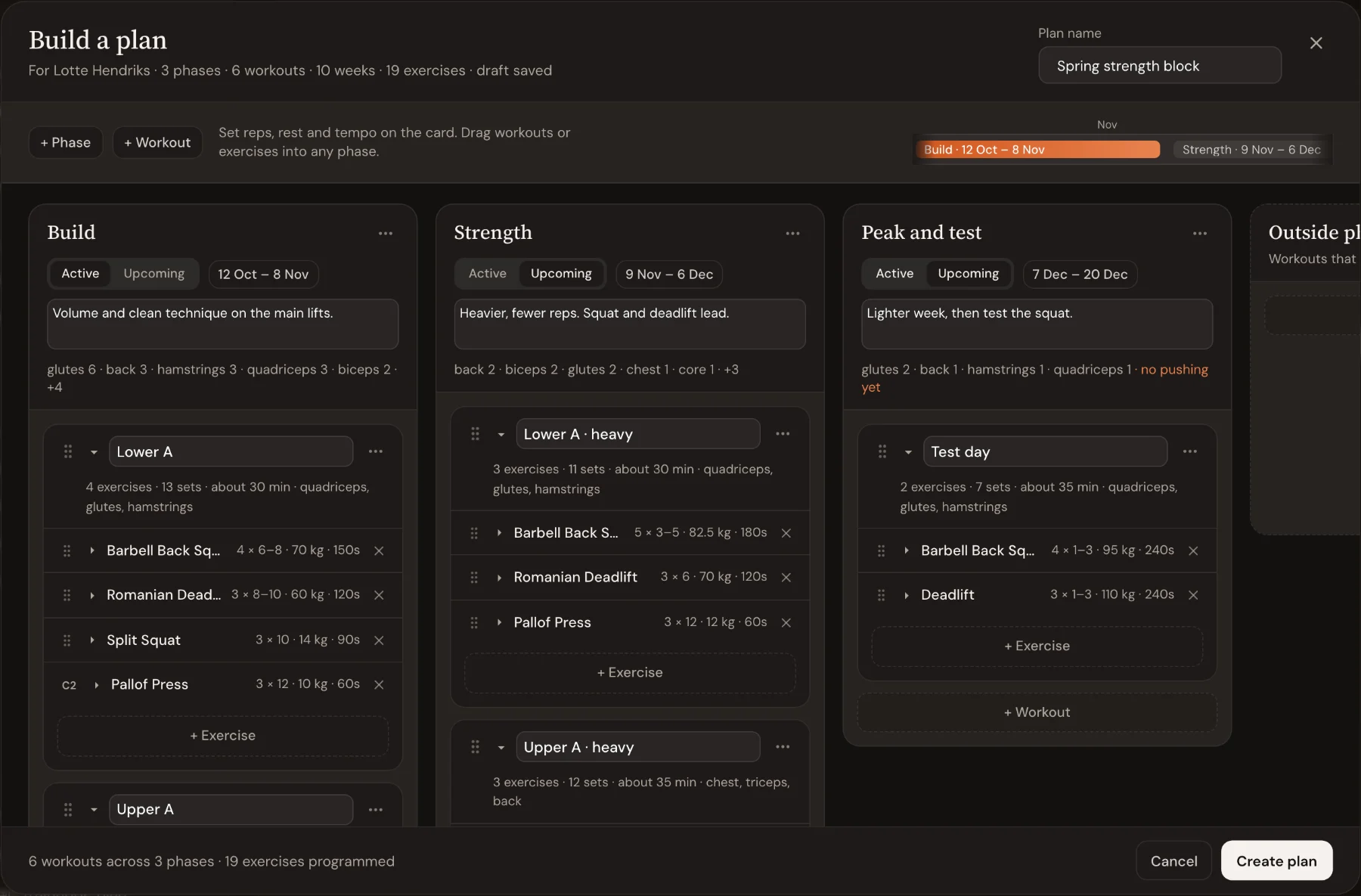
The plan builder in Trainnode lays out a client's phases side by side, so you plan the whole block at once.
- Open the client, go to Training plan and choose Build plan.
- Add phases with dates and a short goal, and mark the current one Active and the rest Upcoming.
- Add workouts to each phase, and set sets, reps, load and rest on each exercise. Drag workouts between phases.
- Each phase shows its muscle spread, and warns you when something is missing, such as no pulling yet.
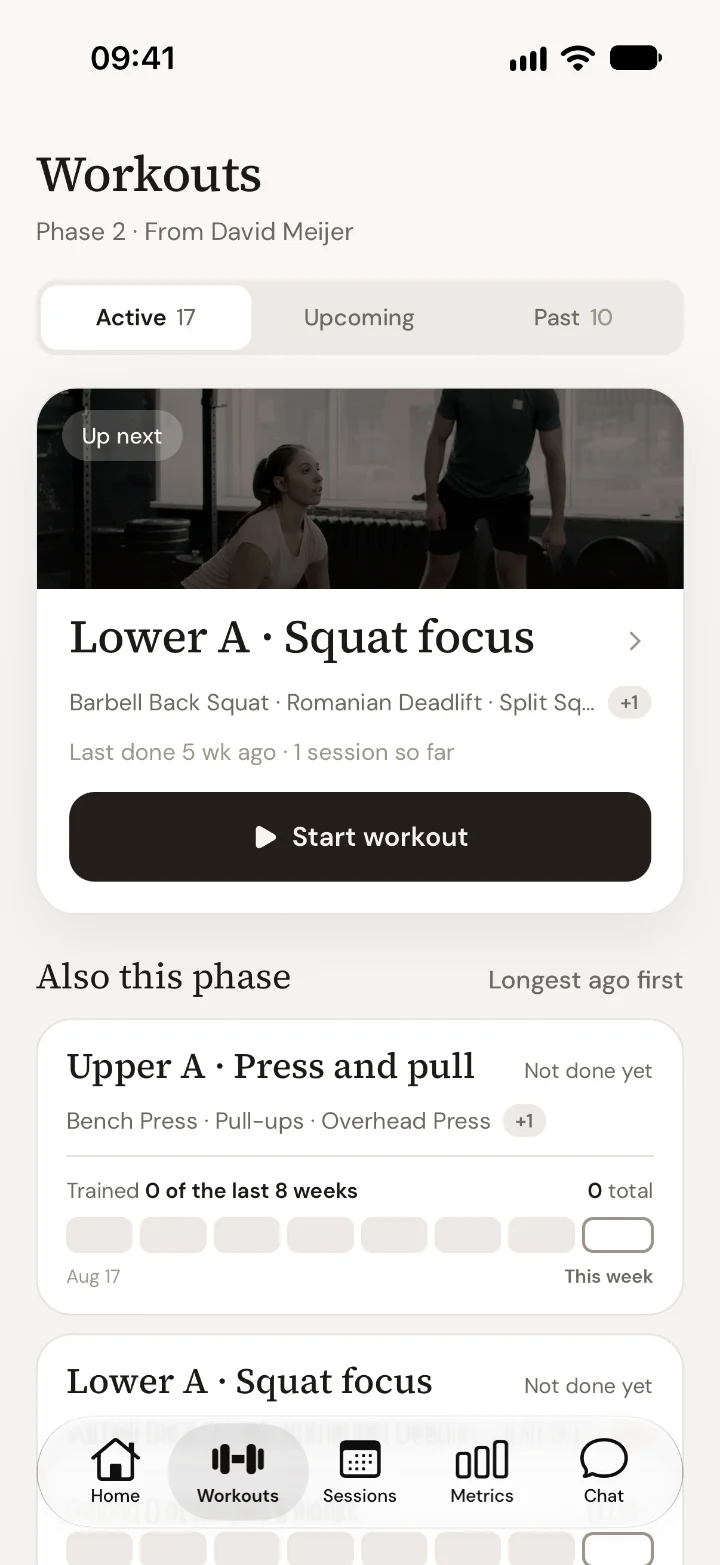
Create plan assigns everything at once. The client sees the current phase in the app, and what comes next under Upcoming.
Questions
Do I need phases for clients who only want to stay fit?
Yes, but lighter ones. Even a client with no performance goals stays more motivated with a goal for the next six weeks.
Should a client know the whole plan?
Show the current phase and the next one. A year of planned training feels far away; the next six weeks feel concrete.
What is a deload?
A lighter week, usually every four to eight weeks, with less volume or load. It lets the body recover and often leads to better numbers the week after.