How to price personal training: session packs vs memberships
Packs, monthly memberships or pay per session? How each works for a PT studio, how to set the price, and the mix most studios end up with.

Coach at Omnia Personal Training and co-founder of Trainnode · 4 min read
How you charge shapes how clients train. A client on a pack trains when they remember. A client on a membership trains on the days they agreed to, because the sessions are already paid for and expire at the end of the month. For most PT studios, that difference matters more than the price itself.
The three ways to charge for personal training
| Session pack | Monthly membership | Pay per session | |
|---|---|---|---|
| How it works | Client buys 10 or 20 sessions up front | Client pays every month for a set number of sessions | Client pays for each session when booking |
| Cash flow | Lumpy: big payments, then nothing | Steady and predictable | Unpredictable |
| Client behaviour | Trains when it suits | Trains on a rhythm | Easy to drift off |
| Admin | Track credits and expiry | Collect monthly, handle pauses | Chase every payment |
| Best for | Irregular schedules, travellers | Your core clients | Intakes, one-offs |
Session packs
Packs are easy to sell because the commitment feels small. The catch is that unused sessions sit on your books for months, and clients who stretch a 10-pack over half a year rarely get the results that would make them buy the next one.
Give every pack an expiry date that matches how often the client should train. Ten sessions valid for three months sets a rhythm of once a week. Ten sessions valid for a year tells the client there is no hurry.
Monthly memberships
A membership sells a habit: two sessions a week, every week. You get a predictable income, and the client gets a reason to show up. Collect it by direct debit, so payment is not something either of you has to think about.
Decide up front what happens to sessions a client doesn't use in a month. Three common choices:
- They expire at the end of the month. Simple, and it keeps clients training. Some find it harsh.
- They carry over for a limited time, for example one month. The usual compromise.
- They never expire. Friendly, but you build up a stock of owed sessions.
Pay per session
Charging each session separately sounds flexible, but it means a payment moment before every session and no commitment between them. Keep it for intakes, trial sessions and the occasional extra session on top of a membership.
How to set the price
Start from what an hour of coaching has to earn, not from what the studio down the road charges.
Price the commitment, not the discount. The membership should be the cheapest per session because it gives you the most certainty. Make the gap visible, and most clients pick the membership themselves.
Don't forget payment costs
Card and iDEAL payments cost a little per transaction. Direct debit is the cheapest way to collect monthly payments in the Netherlands and the rest of the SEPA area, and the one clients forget about once it is set up. In Trainnode, the fee per payment on top of Mollie's own is €0.15 for direct debit, €0.18 for iDEAL, €0.25 for card, €0.25 for bank transfer.
The mix most studios end up with
- One or two memberships: once a week and twice a week.
- One session pack for clients who can't commit to a rhythm.
- A free or paid intake, booked separately.
Three or four products is enough. Every extra option is a decision the client has to make before they can say yes.
Make the cancellation rule match
Your pricing and your cancellation policy work together. With packs and memberships, a late cancellation simply uses a session, so there is never a separate fee to collect.
In Trainnode
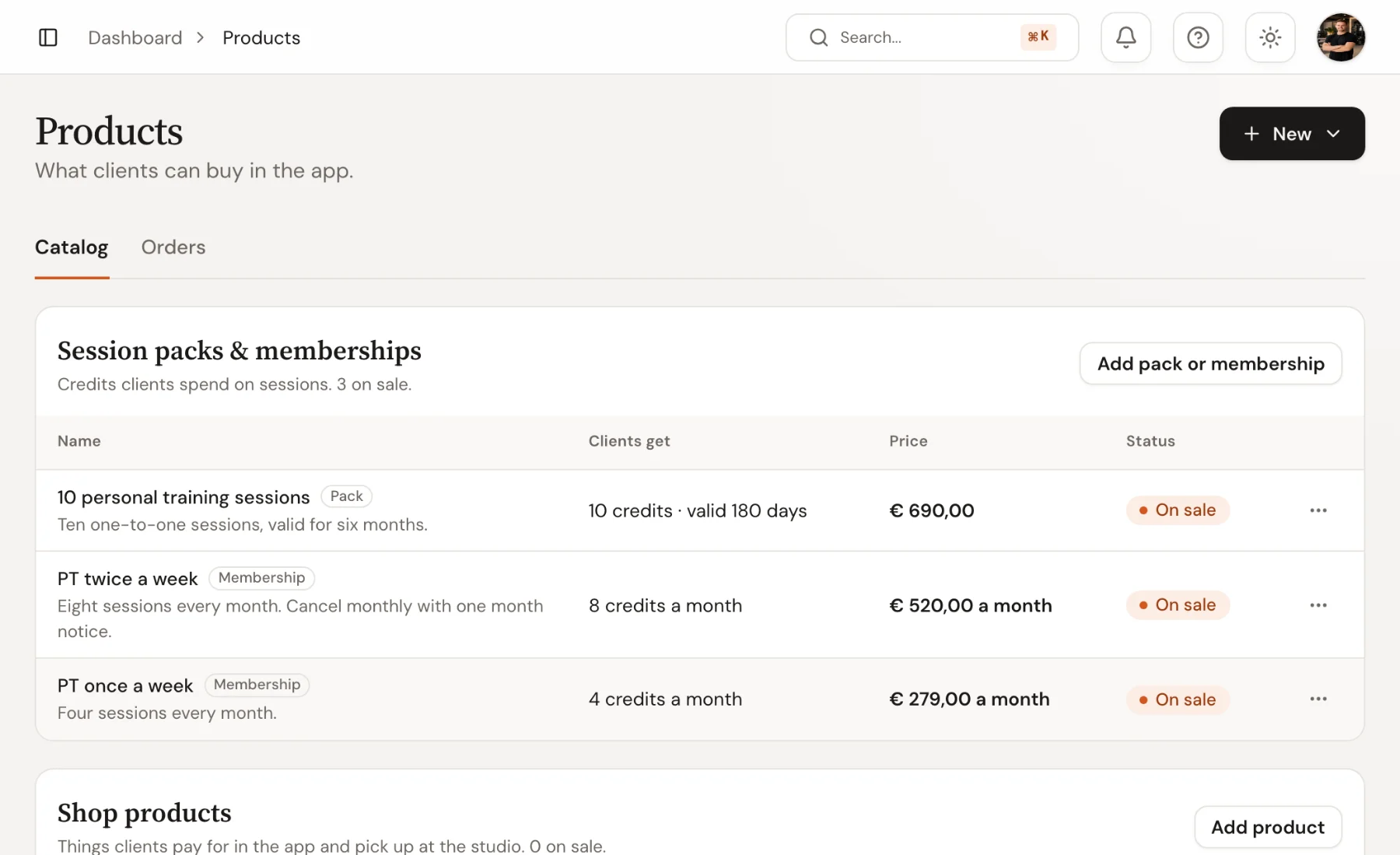
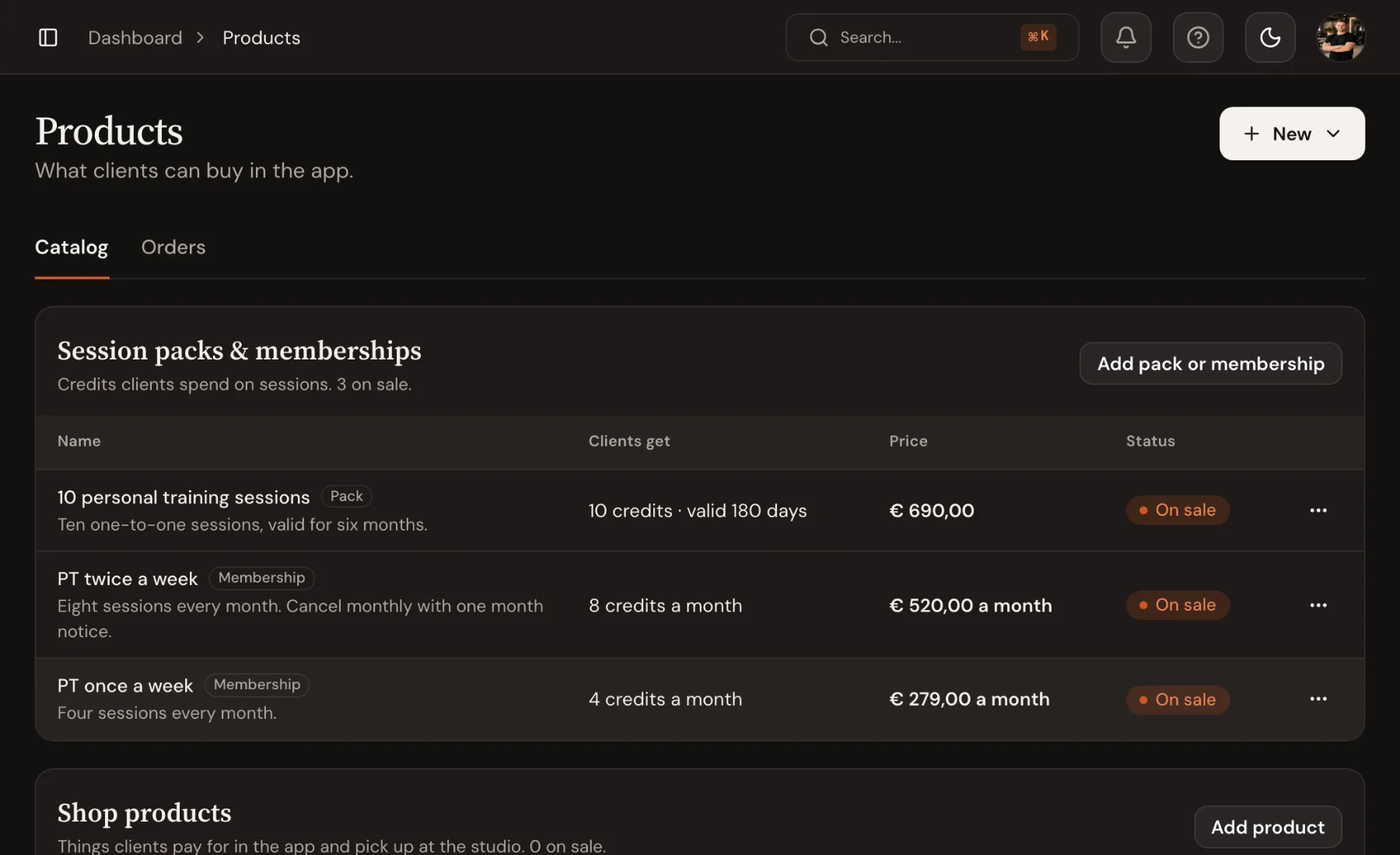
Sell packs and memberships from the app
In Trainnode, packs and memberships both give clients credits, and every booking uses them.
- Under Products, add a session pack or a recurring membership, with the number of credits and how long they stay valid.
- Choose what happens to unused credits: expire at the end of the cycle, carry over for a while, or never expire.
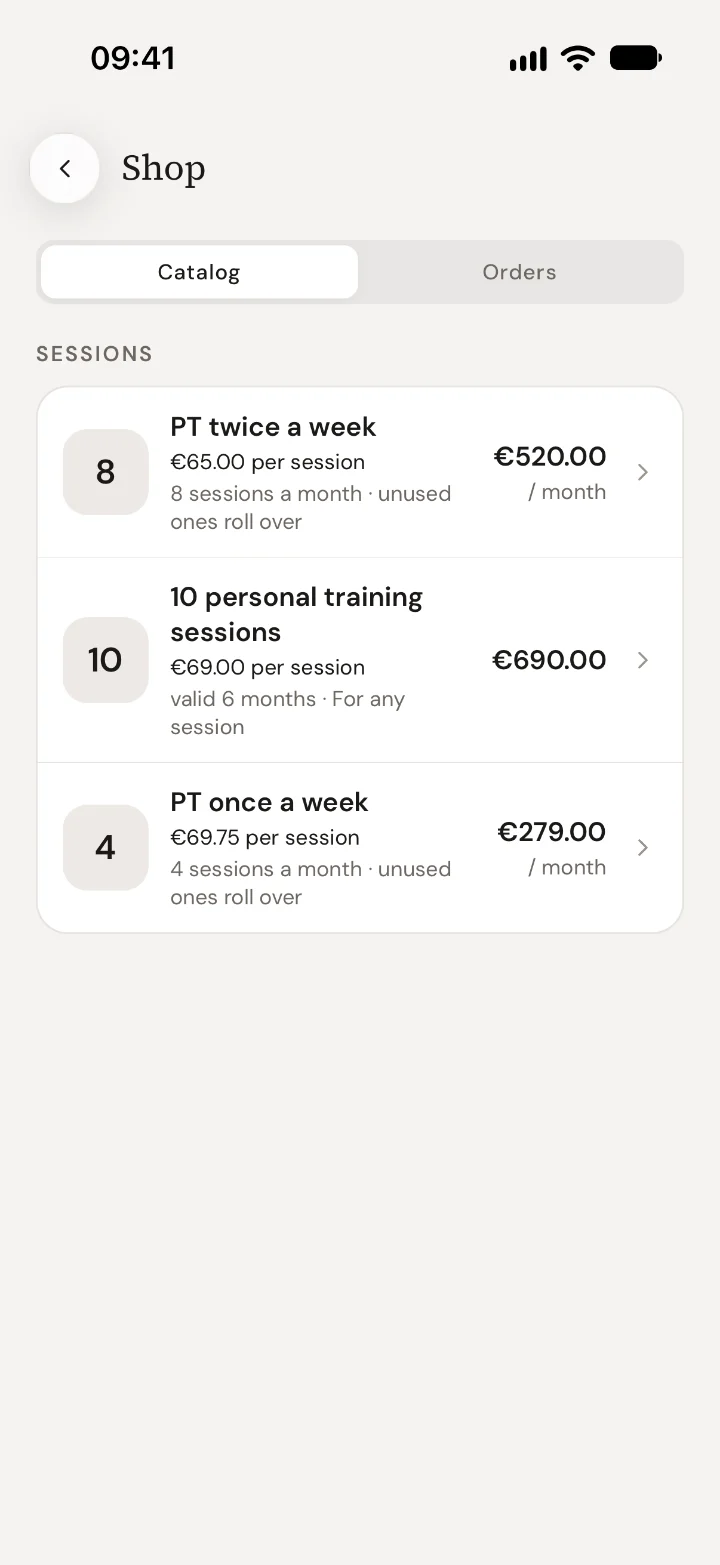
- Clients buy in the app's shop and pay through your own Mollie account, with direct debit for memberships.
Credits land in the client's balance straight away, and the booking screen shows how many they have left.
Questions
Should I show prices on my website?
Show a starting price. Studios that hide prices completely get fewer enquiries from the people who would actually pay them.
How do I raise prices for existing clients?
Give at least a month's notice and let current members keep their price for a set period. In Trainnode, changing a product's price does not change memberships that already run; they keep their agreed terms.
Can a client pause a membership?
Agree on a rule, for example one pause of up to four weeks a year for holidays or injury, and write it in your terms.