Why personal training clients quit, and the signs to watch
The reasons PT clients stop, the early signs weeks before they cancel, and what a coach can do at each stage to keep them training.

Coach at Omnia Personal Training and co-founder of Trainnode · 4 min read
A client cancelling their membership is the last step, not the first. By the time the email arrives, they decided weeks ago. The studios that keep clients longest aren't the ones with the best programs; they're the ones that notice early and say something.
The four reasons clients stop
1. They don't see progress
The client trains, but nothing seems to change. The scale doesn't move, they don't feel stronger, and nobody has shown them otherwise. This is the most common reason, and the most fixable: progress is usually there, it just isn't visible. See How to track client progress beyond the scale.
2. Life gets in the way
A new job, a sick child, a holiday that turns into three weeks off. Training drops down the list, and getting back feels harder each week. These clients want to come back; they need someone to make it easy.
3. The habit never formed
New clients who haven't trained regularly for six to eight weeks are fragile. One busy week can end it. This is why the first 30 days matter more than any other month.
4. The relationship stalls
Sessions become routine, the coach stops asking questions, the client feels like a number. Personal training is personal; when it stops feeling that way, a cheaper gym starts to look the same.
Price comes up when clients leave, but it's rarely the real reason. A client who sees progress and feels known doesn't leave over €20 a month.
The signs, roughly in the order they appear
| Sign | What it usually means |
|---|---|
| A missed week | Something changed in their life |
| Training less often than usual | The habit is weakening |
| Short or slow replies | Motivation is dropping |
| Skipped check-ins | They're avoiding the question "how's it going?" |
| No workout for two weeks | The decision is being made |
| Cancellation request | Usually too late to change |
Not every client shows every sign, and the gaps between them differ. What matters is the order: the first signs come weeks before the cancellation, when a single message can still change the outcome.
What to do at each stage
After one missed week: a short, personal message. Not a reminder of the plan, but a question. "Missed you last week, everything ok? Still good for Wednesday?"
When they train less than usual: ask what changed, then adapt. Two sessions a week becomes one for a month, or a 30-minute session at lunch instead of an hour after work. A smaller plan they keep beats a big plan they skip.
After two quiet weeks: call or offer a specific session. "I've got Thursday at 7:00 free, shall I put you in?" A concrete time is easier to say yes to than "come back when you can".
When they come back: make the first session lighter, say you're glad they're back, and don't mention the gap twice.
Make it a routine
Noticing early only works if someone looks every week. Pick a moment, such as Monday morning before the first session, and go through three questions:
- Who missed last week?
- Who is training less than usual?
- Who hasn't replied or filled in their check-in?
Ten minutes a week, one message each. That's the whole system.
In Trainnode
See who is drifting before they cancel
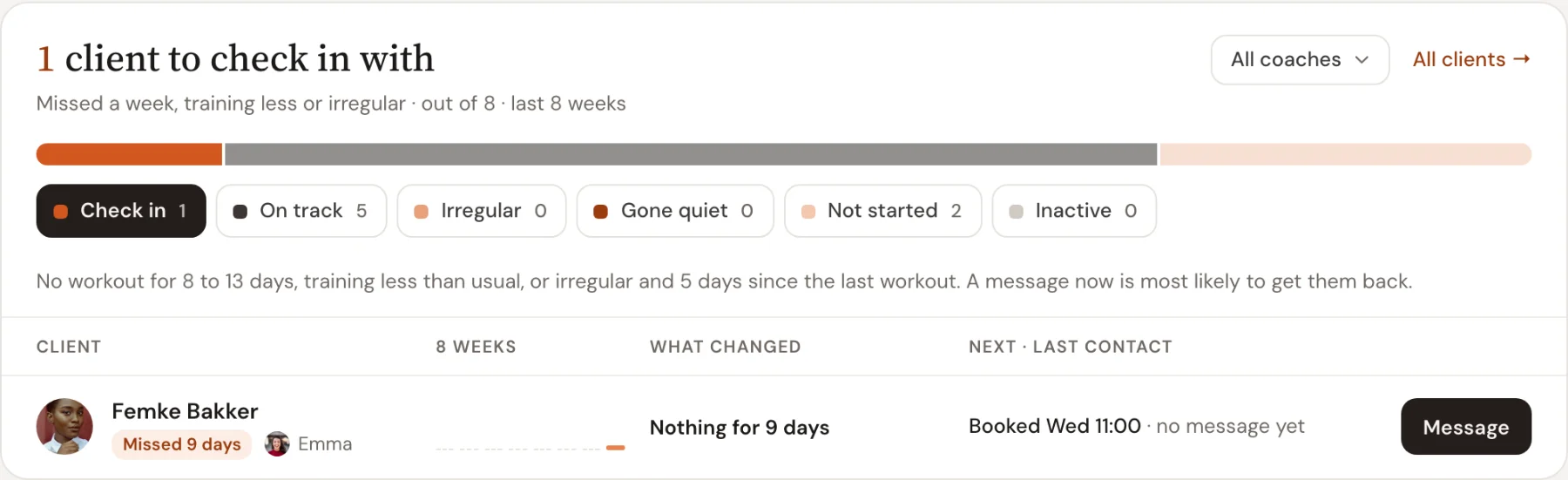
The overview in Trainnode sorts every client by how they've trained over the last eight weeks, so the Monday routine takes minutes.
- Check in lists clients who missed a week, train less than usual, or are irregular and haven't trained for five days.
- Gone quiet lists clients without a workout for two weeks or more.
- Choose Message to write to a client from the same screen, or Message all for the whole group.
Questions
Should I offer a discount to clients who want to cancel?
Rarely. A discount keeps the client for a month without fixing why they wanted to leave. Ask what changed first; often a pause or a smaller plan works better.
What retention rate is good for a PT studio?
It varies a lot by studio and by how you count. More useful is your own trend: how many clients still train with you after 3, 6 and 12 months, compared with last year.
Is it pushy to message a client who missed a week?
Not if the message is about them, not about the plan. Most clients appreciate that someone noticed.
Who should send the message, the coach or the owner?
The client's own coach. A message from the person they train with feels like care; the same message from the owner can feel like a sales call. Owners can step in when a client has gone quiet for longer, with a call rather than a text.